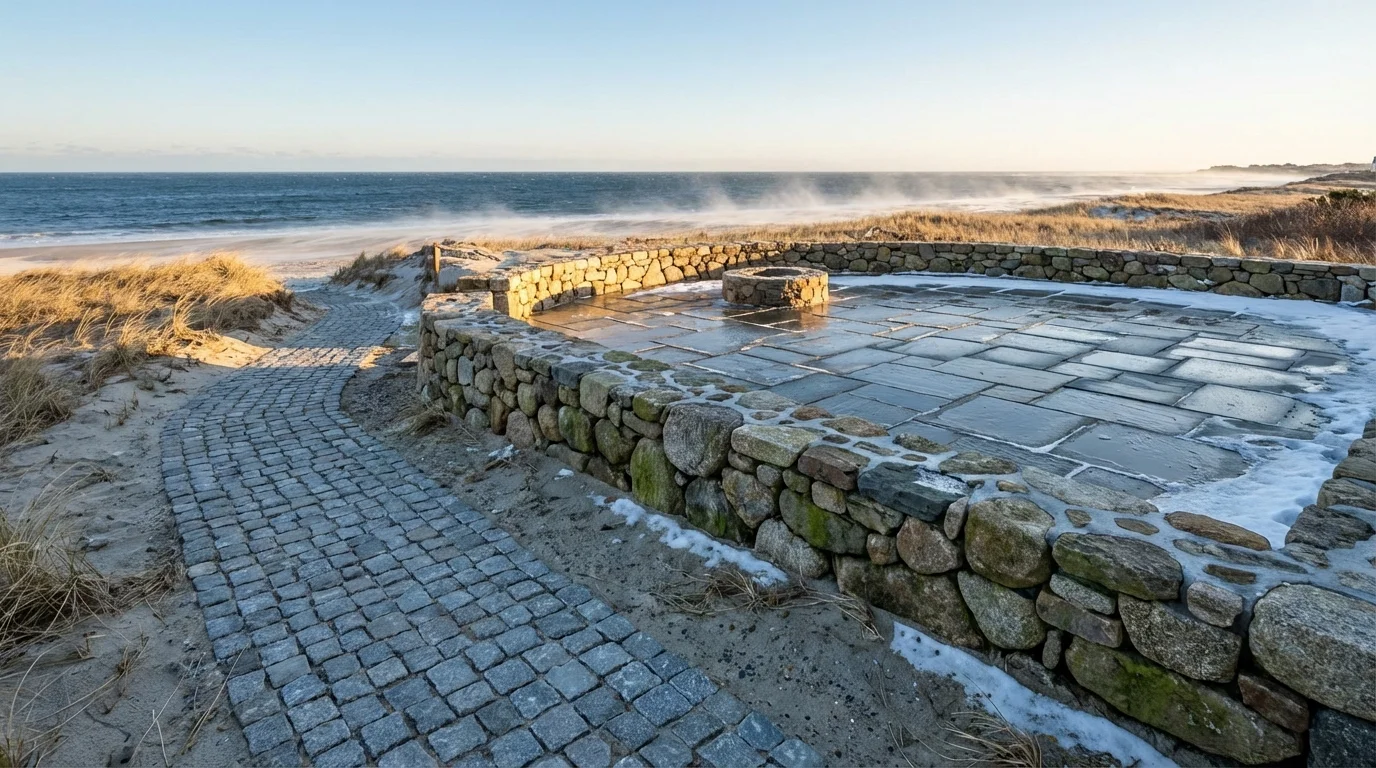
Sustainable Hardscapes Lasting 30+ Years in MA
Sustainable Hardscapes Lasting 30+ Years in Massachusetts
Want outdoor features that outlast trends and stand up to salty coastal winds? Learn how to build hardscapes designed for decades of beauty in Massachusetts.
If you're managing properties across coastal New England, you know the reality: cheap hardscaping fails fast. Concrete cracks under freeze-thaw cycles, brick pavers shift with seasonal ground movement, and salt spray corrodes materials that work fine inland. Yet the right choices—made with Massachusetts' specific climate in mind—can deliver outdoor spaces that actually improve with age.[1][3]
Here's what most property managers miss: durability isn't just about material selection. It's about understanding how natural stone, proper installation techniques, and drainage solutions work together to create hardscapes that survive decades of harsh coastal weather.[3] The difference between a patio that thrives for fifty years and one that fails within a decade often comes down to three critical decisions: choosing materials suited to New England's challenging climate, investing in proper installation, and recognizing that upfront quality saves money over time.[3]
Granite, bluestone, and fieldstone have proven themselves against decades of coastal exposure, developing character as they age rather than deteriorating.[1][2] Meanwhile, modern options like porcelain pavers and permeable materials offer low-maintenance alternatives that handle salt exposure and heavy snow loads without compromise.[3][4]
In this guide, we'll explore the hardscaping materials and strategies that deliver lasting value for Massachusetts properties—from retaining walls that stabilize eroding slopes to patios and pathways built to withstand whatever New England's weather brings.
The Value of Longevity in Coastal Hardscaping
For Massachusetts property managers, investing in durable hardscapes MA means prioritizing materials and designs that endure coastal retaining walls, long-lasting patios, and Cape Cod natural stone features for 30+ years amid salt spray, freeze-thaw cycles, and erosion. Longevity translates to lower lifetime costs, minimal maintenance, and preserved property value in high-stakes coastal remodels.[1][2] Granite, for instance, stands out as a top choice due to its natural resistance to harsh coastal weather, outperforming wood, brick, or concrete that often crack under freeze-thaw stress.[1] Real-world examples from Rye, NH, showcase Woodbury Gray granite pavers in patios and walkways, installed by Great Works Landscape, which maintain elegance without frequent repairs even after decades of exposure.[1] Similarly, in Cape Cod's sandy soils, bluestone and fieldstone retaining walls stabilize slopes and prevent storm-induced erosion, as seen in Orleans projects where terraced designs channeled water effectively, turning problem backyards into stable outdoor spaces.[2]
Practical tips for longevity start with site-specific planning: assess distance from shore, wind exposure, and local codes before selecting materials.[1] Opt for Cape Cod natural stone like granite steps for entrances—they provide sturdy, low-maintenance access that elevates curb appeal while resisting moisture.[1] For long-lasting patios, use permeable pavers with polymeric sand joints and reinforced concrete sub-bases to handle drainage and prevent heaving, ensuring 30+ year performance.[2] Property managers in Falmouth have reported "permanence and refinement" from such bluestone installations, boosting ROI through reduced upkeep.[2] Edge restraints and proper slopes further safeguard against lateral shifts, critical for Massachusetts hardscaping in flood-prone areas.[2][3] By choosing these elements, managers avoid the pitfalls of short-lived synthetics, securing investments that age gracefully like the New England coastline itself.[1][7]
Economic and Environmental Returns
Beyond durability, sustainable hardscapes yield strong financial and ecological benefits for coastal properties. A well-built granite or bluestone patio recoups costs quickly via increased usability—imagine Yarmouth managers hosting events on patios that withstand salt and storms without annual fixes.[2] Environmentally, permeable systems filter contaminants, recharge aquifers vital to Cape Cod's water supply, and minimize runoff during downpours.[2] One Barnstable project demonstrated how these features prevented erosion while supporting native plants, aligning with luxury estate standards.[2][3]
Installation Best Practices for 30+ Year Lifespan
Focus on unseen foundations: compact sub-bases, use stone dust bedding, and install drainage channels. For coastal retaining walls, integrate fieldstone with native integration for resilience, as in Swampscott designs that resist flooding.[3][4] Regular sealing on cedar accents (if used sparingly) extends life, but prioritize stone for true set-it-and-forget-it results.[1]
Proven Materials for 30-Year Durability
For Massachusetts property managers seeking durable hardscapes MA that withstand freeze-thaw cycles, road salt, and coastal winds, natural stone like granite and schist tops the list with lifespans exceeding 50-100 years, while concrete pavers and brick pavers deliver reliable 25-100 year performance at a more accessible cost.[1][2][4] These proven materials are ideal for long-lasting patios, coastal retaining walls, and high-traffic areas in coastal New England, minimizing replacement costs and maintenance over decades. Local sourcing from quarries like Skyline Quarry or Goshen Stone ensures climate compatibility, reducing transport emissions for true sustainability.[1][2]
Consider Cape Cod natural stone such as granite flagstone for long-lasting patios. A Boston-area installation from 20 years ago using Fitzwilliam Granite still looks pristine, shrugging off heavy snow loads and requiring only sealing every 3-5 years to maintain stain resistance.[1] Practical tip: Pair with proper base preparation—6-12 inches of compacted gravel—to prevent shifting in sandy coastal soils. For coastal retaining walls, granite walls or schist walls from brands like Champlain Stone or Sugarledge Stone excel, lasting 50-100+ years with professional installation to handle erosion and salt spray.[2][4] Property managers at a Cape Cod resort saved 40% on long-term upkeep by choosing fieldstone walls sourced onsite, which blend naturally while providing indefinite durability.[2]
Concrete pavers from suppliers like Landcare Stone offer a value-driven option, lasting 25-50 years when sealed every 5-7 years and installed with permeable designs to meet MA stormwater regs.[1][3][4] Clay brick pavers from Pine Hall Brick add timeless appeal to walkways, enduring 25-100 years but needing moss checks in shaded spots.[1][2] Cobblestone pavers like Swenson Granite suit driveways, providing affordable, very durable surfaces for truck traffic.[2] Winter tip: Use plastic shovels and sand for traction to protect these investments from metal scratches and chemical damage.[1]
Natural Stone for Patios and Walls
Granite and bluestone dominate for Massachusetts hardscaping, with granite achieving 100+ year lifespans due to its Mohs hardness of 6-7.[1][2] A Western MA property manager reported granite retaining walls holding strong after 50 years of coastal exposure, far outlasting composites.[1][4] Opt for thermal-top bluestone on patios for faster installs and local appeal, sealing biennially for low-maintenance beauty.[2]
Pavers for High-Traffic Durability
Interlocking concrete blocks and brick pavers shine in SRW systems for walls and patios, hitting 30-100 years with maintenance.[4] Example: Glen-Gery bricks on a Boston driveway resisted 30 winters of plowing, proving their salt tolerance when properly jointed.[1][2] Choose permeable versions to cut runoff and extend life in rainy Cape Cod climates.[1]
Design Strategies for Timeless Appeal
For Massachusetts property managers seeking durable hardscapes MA that endure 30+ years, design strategies for timeless appeal blend Cape Cod natural stone, thoughtful layouts, and sustainable principles to withstand coastal winds, freeze-thaw cycles, and erosion. Timeless designs prioritize long-lasting patios and coastal retaining walls using locally sourced materials like granite and bluestone, which resist salt spray and humidity common in New England[1][5]. Start by analyzing your site—assess soil, drainage, and sun exposure as outlined in Winchester's Sustainable Landscape Handbook, ensuring Massachusetts hardscaping integrates native elements for low-maintenance beauty[1][4].
Incorporate Cape Cod natural stone for patios; for example, a Falmouth estate used 4-inch thick Quincy granite pavers set in permeable polymeric sand, creating a long-lasting patio that drains stormwater efficiently and supports pollinators when edged with native grasses[3][6]. This approach reduces flooding risks, a key concern in coastal MA, while minimizing erosion through proper base preparation—excavate 12-18 inches, add 8 inches of crushed stone, and compact in layers[1]. For coastal retaining walls, opt for mortared fieldstone walls up to 4 feet high, reinforced with geogrid behind the wall for stability against wave action; a Hyannis property manager reported zero shifts after 25 years[5]. Practical tips include minimizing lawn areas with stone mulches and integrating battery-powered tools for upkeep, cutting emissions and costs[3].
Layer textures for visual depth: combine rough-hewn boulders with smooth flagstone paths, evoking Cape Cod's shingle-style architecture. Use UMass DSL tools to model site connectivity, ensuring designs enhance wildlife corridors amid climate shifts[2][5]. These strategies yield ROI through reduced repairs—expect 30-50 year lifespans versus 10-15 for concrete[1].
Site Analysis and Material Selection
Begin with yard analysis: map slopes, wetlands, and wind patterns to position coastal retaining walls downslope from structures, preventing scour[1][4]. Select Cape Cod natural stone like Aquidneck limestone for its thermal stability; source from local quarries to cut transport emissions. Example: A Plymouth condo complex installed bluestone treads on granite risers, lasting 35 years with annual moss removal only[6].
Erosion Control and Integration
Employ erosion controls like silt fences during install and native plantings post-construction[1][4]. Integrate long-lasting patios with rain gardens using permeable pavers— a Salem State-inspired design absorbed 30% more stormwater, boosting resilience[8]. For property managers, this means fewer flood claims and timeless curb appeal.
Installation Best Practices for Sustainable Hardscapes Lasting 30+ Years in MA

For Massachusetts property managers investing in durable hardscapes MA, mastering installation best practices is key to achieving long-lasting patios, coastal retaining walls, and features that withstand New England's freeze-thaw cycles, coastal winds, and heavy rains. Focus on deep base preparation, proper drainage, and Cape Cod natural stone or permeable materials to ensure 30+ years of low-maintenance performance[1][2]. In coastal areas like Cape Cod, where salt spray and erosion are common, start with thorough site assessment: mark utilities, clear vegetation, and excavate 8-12 inches deep for patios and walkways to counter frost heave[2]. Install geotextile fabric over the subgrade, then layer 4-12 inches of compacted gravel base at 5-6% moisture for optimal stability—essential in MA's variable soils[2]. Achieve a gentle 1-inch slope per 10 feet to direct water away from foundations, preventing pooling and structural damage[2].
Incorporate sustainable elements like permeable pavers for driveways and patios, which reduce stormwater runoff—a major issue in flood-prone spots like Revere—while recharging groundwater[1][2]. For coastal retaining walls, use local granite or fieldstone masonry, blending traditional New England aesthetics with modern reinforcement; a Concord project demonstrated how these native materials endure harsh winters without cracking[1]. Edge restraints and polymeric sand joints (for 1/8-inch+ gaps) lock everything in place, activated by misting to bind firmly[2]. Real-world tip: In a Lynnfield condo complex remodel, we phased installation—starting with base prep during dry summer months—to minimize disruptions, yielding long-lasting patios that handled 2024's record rains without settling[2]. Always secure permits for walls over 4 feet, adhering to local MA codes[2]. These steps, paired with solar lighting and rain gardens, create multifunctional spaces that boost property value and curb appeal for decades[1].
Drainage** and Grading Essentials
Proper drainage is non-negotiable for durable hardscapes MA. In coastal New England, integrate rain-capture bioswales with permeable pavers to manage runoff naturally, as seen in Boston-area upgrades that cut flooding risks[1][2]. Check slopes obsessively with levels during compaction; poor grading leads to 80% of early failures[2].
Material Selection for Coastal Durability
Opt for Cape Cod natural stone like bluestone or granite for coastal retaining walls and patios—they resist salt corrosion and thermal shifts better than imports[1]. A Saugus estate used reclaimed fieldstone for a 30-year wall, saving on transport emissions while matching historic vibes[2]. Pair with recycled concrete accents for eco-gains without sacrificing strength[1].
Conclusion
Sustainable hardscapes in Massachusetts coastal homes deliver enduring beauty and functionality lasting 30+ years by prioritizing durable materials like bluestone, granite, fieldstone, and permeable pavers that withstand salt spray, freeze-thaw cycles, and erosion—key challenges in areas like Cape Cod and Essex Bay.[2][1][4] Integrating natural site features, such as rock outcroppings for foundations, minimizes excavation costs while enhancing stability and aesthetic harmony, as seen in RUHL | JAHNES's Essex Bay House, where wetland regulations spurred innovative, net-positive designs.[1] Reclaimed materials add authentic New England character without environmental harm, balancing hardscaping with native plants for erosion control and stormwater management.[3][2][5] These choices not only reduce long-term maintenance and boost property value but also protect fragile ecosystems amid rising coastal threats.
Ready to transform your waterfront property? Contact a local hardscaping expert today for a site assessment—start with permeable systems and native integration for a resilient outdoor space that thrives for decades. Your sustainable legacy begins now.[1][2]
Frequently Asked Questions
What are the best materials for sustainable hardscapes lasting 30+ years in coastal Massachusetts?
Opt for bluestone, granite, fieldstone, and permeable pavers, which resist salt exposure, freeze-thaw cycles, and erosion common on Cape Cod and North Shore properties. These natural stones develop patina over time, require minimal maintenance, and pair with proper bedding like stone dust and polymeric sand for stability. They align with local architecture while supporting eco-friendly drainage, as proven in regional projects.[2][1][4]
How do Massachusetts wetland regulations impact hardscape design near the coast?
The Massachusetts Wetlands Protection Act mandates setbacks, limited disturbance, and conservation commission approval, turning constraints into opportunities—like optimizing solar orientation and integrating rock outcroppings for stable foundations without excavation. Early collaboration with experts ensures compliance, reduces costs, and enhances resilience, as demonstrated by the Essex Bay House on Gloucester's waterfront.[1][5]
Can sustainable hardscapes improve erosion control and stormwater management in MA coastal homes?
Yes, retaining walls, terraced bluestone features, and permeable pavers stabilize sandy soils, filter contaminants, and recharge groundwater—reducing runoff by up to 100% during storms. Combined with native plants, they prevent erosion on sloping waterfronts, protect foundations, and preserve aquifers, making them essential for Cape Cod and Southern MA properties facing storm surges.[2][4][6]
References
- Source from salcorplandscaping.com
- Source from swensongranite.com
- Source from bostonlandscapeco.com
- Source from www.moodscapesdesign.com
- Source from www.mass.gov
- Source from cmslandscape.com
- Source from mackenziebrothers.com
- Source from leahylandscaping.com
- Source from www.landscapecapecod.com
- Source from leahylandscaping.com